


If you've hired software vendors before, you probably know the feeling. The missed deadlines. The change orders that triple your budget. The code that works in demos but crashes in production.
You're not alone. 31.1% of software projects are canceled before completion. 41% run over budget. Perhaps most telling, 75% of IT executives believe their projects are doomed from the start.
These statistics represent expensive lessons that cost companies time, money, and market opportunities.
It's time for an honest assessment of when dedicated development teams work, and when they don't. We're drawing from 10 years at Sketch Development Services, where we've never missed a deadline. That track record comes from understanding that dedicated teams aren't right for everyone, but when they fit, they transform how software gets built.
TL;DR: What You'll Learn
- A dedicated development team is an outsourced team working exclusively on your software project
- Best for: Long-term projects, evolving requirements, specialized technical needs
- Not for: Small one-time tasks, extremely limited budgets, projects requiring daily micromanagement
- Key considerations: Track record, communication model, technical expertise, and cultural fit
- Sketch's differentiator: No change orders policy, 100% US-based teams with Fortune 500 enterprise experience, working software every two weeks
What is a Dedicated Development Team?
A dedicated development team is an outsourced group of software engineers, designers, product managers, and specialists who work exclusively on your product. Unlike traditional outsourcing where teams juggle multiple clients, a dedicated team operates as an extension of your internal team without the overhead of full-time hiring.
Think of it as having an in-house team without the recruiting, benefits, or administrative burden. The team focuses solely on your project, typically for engagements lasting three months or longer.
The model has gained significant traction. The global IT outsourcing market reached $618.13 billion in 2025 and is projected to hit $732.38 billion by 2030. Even more telling, 92% of Forbes Global 2000 companies, and software outsourcing is expected to grow from $585.5 billion in 2024 to $897.9 billion by 2031.
In other words, this is how modern software gets built.
How Dedicated Teams Differ from Other Models
The market offers several engagement models, each with distinct advantages and limitations. At a high level, these are the differences between in-house teams vs. dedicated development teams vs. staff aug vs. project-based outsourcing:
|
In-House Team |
Dedicated Dev Team |
Staff Augmentation |
Project-Based |
|
|
Hiring Time |
10+ weeks |
2-4 weeks |
1-2 weeks |
Varies |
|
Flexibility and Scalability |
Limited |
High |
Medium |
Low |
|
Cost Structure |
High fixed costs |
Variable, scalable |
Hourly/monthly |
Fixed price |
|
Communication |
Daily internal |
Daily standups, biweekly demos |
Normally internal |
Spotty |
|
Best For |
Core functions |
Scaling, long-term |
Specific skill gaps |
Small projects |
|
Management |
More overhead, more control |
Less overhead, flexible control |
More overhead, more control |
Less overhead, less control |
|
Expertise |
Depends who you've already hired |
Get exactly who you need |
Get exactly who you need |
Get exactly who you need |
|
Security and Risk Management |
Most control |
Medium control, trust is paramount |
High control |
Least control, trust is paramount |
The average time to fill internal IT positions is 10 weeks. Dedicated teams bypass these delays (and the costs, too). Hiring new tech talent costs an average of $23,000, and then it's $15,000 more to upskill existing employees.
Of course, there are risks to outsourcing software development, too. Security is an especially big concern, so it's vital to choose a partner you can trust.

The Sketch Difference - Why We're Trusted by the Best
Not all dedicated teams are created equal. At Sketch, we've built our model around principles that address the common failure points in software projects:
- 100% US-based teams eliminate timezone coordination headaches and give you access to the most experienced talent pool in the world.
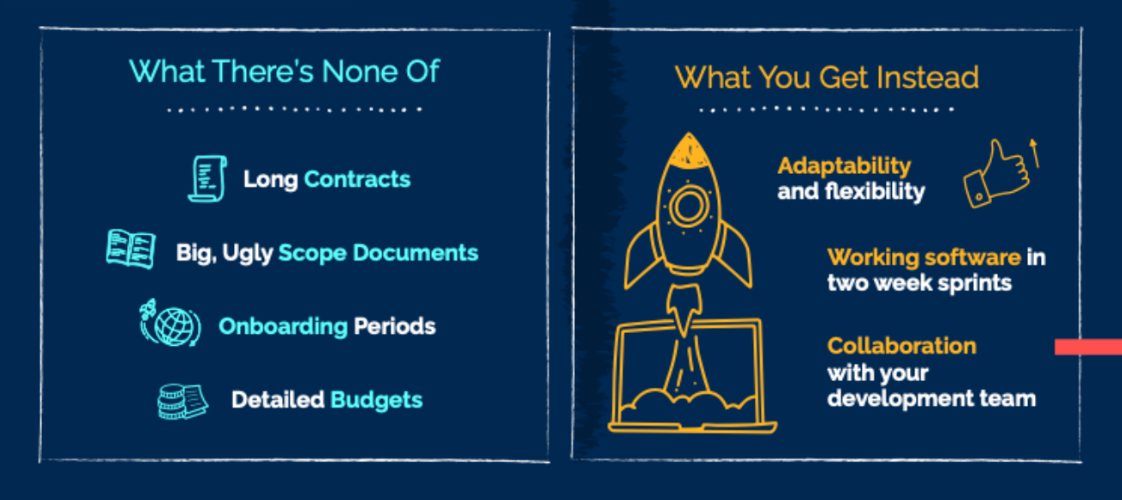
- No change orders policy means we build the right thing iteratively rather than locking you into outdated specs.
- Working software every two weeks (including after the first two weeks) provides real feedback loops.
- SNL-inspired collaborative methodology turns individual contributors into high-performing ensembles. Yes, seriously.
We'll explore these differentiators in depth later in this guide.
Who's on a Dedicated Development Team?
A dedicated software development team typically includes multiple specialized roles working together. The exact composition depends on your project's technical requirements and business objectives. It also depends on who you hire, as some vendors like to load up the team (and your budget) with unnecessary roles.
Standard Dedicated Development Team Composition
Depending on where you look, you might find all of these roles on the most bloated teams:
- Product Manager – Oversees the development process, coordinates tasks, manages timelines, and ensures project goals are met. The PM serves as the primary link between the development team and your stakeholders, maintaining a high-level overview of project/product status.
- Technical Lead / Architect – Makes architectural decisions, ensures code quality, and provides technical direction. This role bridges business requirements and technical implementation, ensuring the solution scales and maintains quality standards.
- Frontend and Backend Developers – Write, test, and maintain the software code. These engineers are experts in programming languages and frameworks, building and implementing solutions based on your requirements.
- UX/UI Designers – Create intuitive, user-friendly interfaces that align with your product goals. They work closely with developers to ensure the interface is accessible, usable, and meets quality standards.
- QA Specialists – Test software, identify bugs, and ensure quality before release. They develop test plans, provide feedback for improvements, and verify that software meets quality standards.
- DevOps Engineers – Manage deployment pipelines, automate processes, and ensure seamless integration, testing, and deployment. They maintain infrastructure and enable continuous delivery.
That's not how we do things at Sketch, though. We hire multi-talented individuals and build cross-functional teams. In other words, every one of our developers also brings the product management, architecture, QA, and DevOps skills required to see your project all the way through. We won't tack extra people onto your project.
The Collaborative Model
This approach draws from our SNL-inspired methodology. When talented people trust each other enough to take creative risks together, it yields better software. This is especially true when team members have enough capability and authority to self-organize around challenges. This collaborative approach, combined with our micro-release methodology, enables empowered teams to increase feature delivery speed by 400% while improving quality.
Scalability and Skills Gap Reality
Dedicated teams can scale up or down based on project needs. This flexibility matters more than ever given the current talent landscape.
76% of companies report having a tech skills gap in their departments, and 65% of tech leaders say these gaps have a greater impact today than a year ago. The numbers grow more concerning when you look ahead. The global shortage of software engineers may reach 85.2 million by 2030.
A dedicated team provides immediate access to specialized skills without the months-long hiring process or the risk of building internal expertise you may only need temporarily.
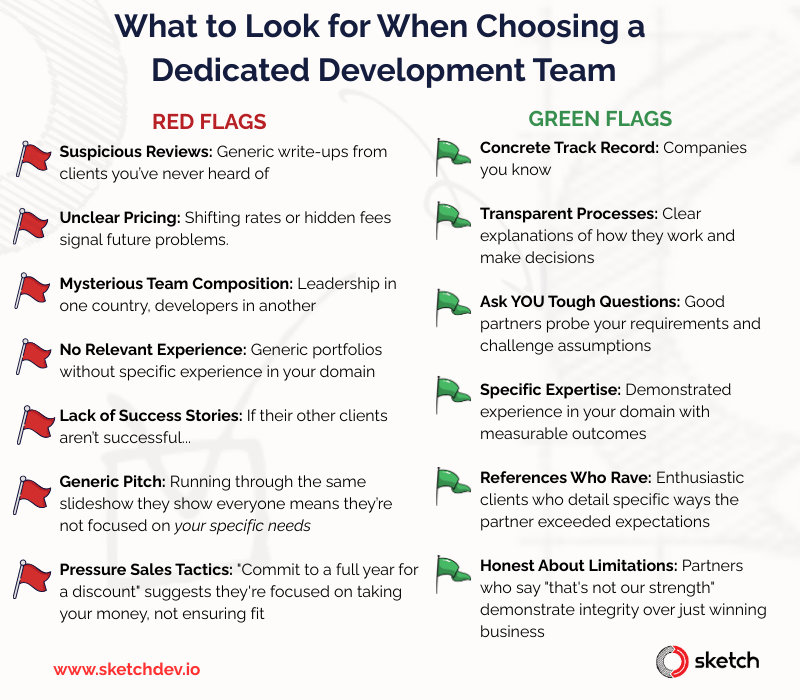 Keep an eye out for these signs before you hire a dedicated development team
When You Should Hire a Dedicated Development Team
Dedicated development teams excel in specific scenarios. Understanding when they fit best helps you make the right choice for your situation.
Scenario A: You're Scaling an MVP and Need Consistent Velocity
Your in-house team is at capacity. Every new feature request creates tension between maintaining existing systems and building new capabilities. Hiring takes too long, and you're losing market momentum.
This is where dedicated teams shine.
The data supports this approach. Only 16.2% of software projects are completed on time and within budget. At Sketch, we've broken this pattern by delivering working software every two weeks through our iterative process.
Consider our work with a cybersecurity company. They had an MVP, which they'd built with a low-code solution. They were starting to get traction, though, and their platform wasn't scalable enough. Sketch helped them continue the momentum by delivering a brand new platform two months ahead of schedule, all without interrupting service.
Scenario B: Requirements Are Evolving and You Need Adaptability
48% of developers cite changing or poorly documented requirements as the leading cause of project failure. Software development is a discovery process. You learn what works by building, testing, and iterating.
This is why Sketch has a no-change-orders policy. Instead of locking you into specifications written months ago, we promise: We will build something in two weeks, and ask you if it's how you wanted it. Then we'll deliver more software every two weeks until you have exactly what you need. Compare that to companies that claim to be "agile" but start with a prototyping phase before they get into development.
Sketch's model allows you to course-correct based on real user feedback. When you discover that users need different functionality, we adapt. When business priorities shift, we pivot. The two-week cycle keeps feedback loops tight and decisions data-driven.
Research backs this approach: companies with formal technical debt strategies ship 50% faster than competitors. We see it in our own clients, too, like when they double feature acceptance, shorten delivery times from months to weeks, and ultimately launch apps faster.
Scenario C: You Need Specialized Expertise Your Team Lacks
87% of technology leaders face challenges finding skilled talent. For example, you might need expertise in:
- AI-enabled development that goes beyond ChatGPT prompts to integrate AI directly into workflows
- AWS cloud architecture for migration or optimization
- Atlassian implementation configured for how teams actually work
- DevOps and CI/CD to automate deployment pipelines
Building this expertise internally takes months or years. Hiring specialists is expensive and time-consuming. A dedicated team provides immediate access to proven expertise.
Scenario D: You've Been Burned by Vendors Who Over-Promise
Trust is earned through track records. We've already covered the stats about how many projects fail, blow the budget, and drag on past their deadlines. You've probably experienced it for yourself, too:
- The vendor who promised revolutionary results but delivered mediocre software.
- The consultants who talked a good game but couldn't execute.
- The "US-based" company that ships your work overseas.
Sketch has a track record of delivering for the world's most successful companies. One of our clients, a VP of Cloud Enablement, put it this way: "I never felt like we were the customer and they were our vendor. It always felt like we were partners in this together."
That's the relationship we build with every engagement, and we have the enterprise references to prove it.
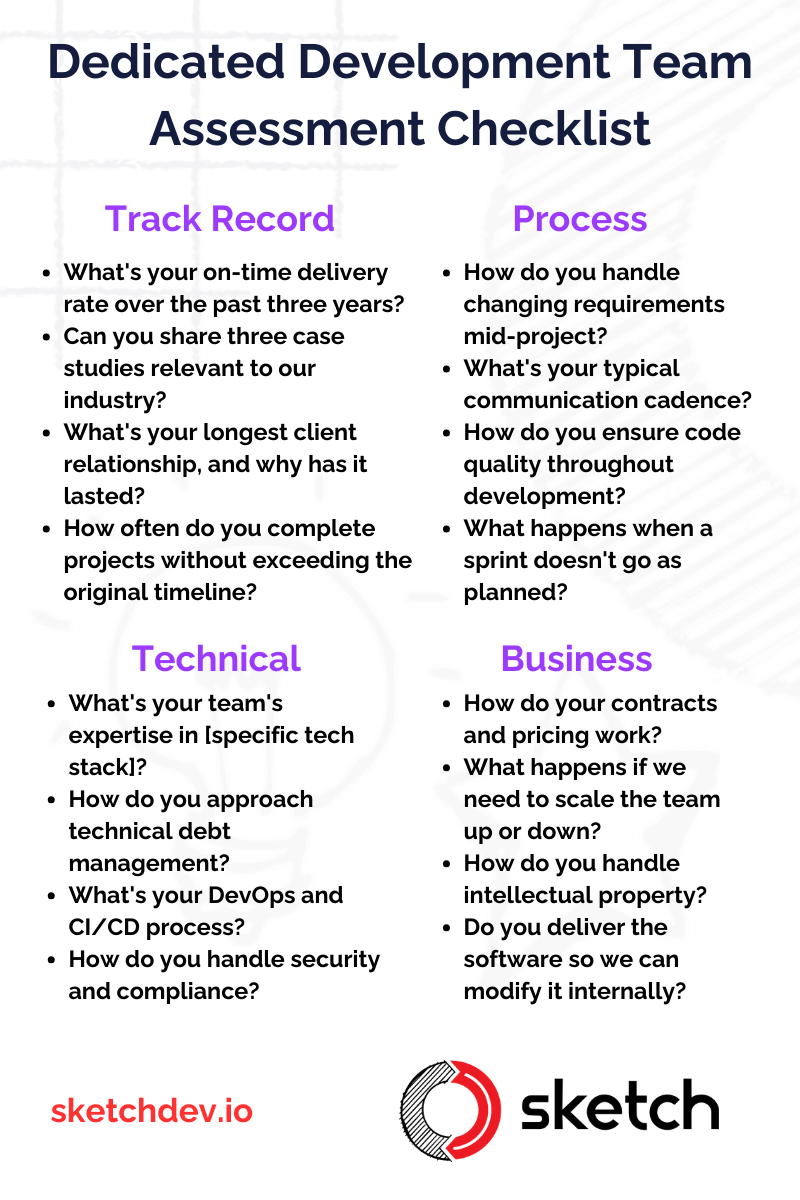
Use this dedicated development team assessment checklist if you're not sure how to evaluate potential partners.
When You Should NOT Hire a Dedicated Development Team
Honesty about poor fits builds more trust than claiming we're right for everyone. Here's when dedicated teams don't make sense:
Small, One-Time Projects (Under 3 Months)
If you need a simple website update, a minor feature addition, or a quick proof of concept, a dedicated team is overkill. The value of dedicated teams comes from sustained engagement where the team develops deep product knowledge and can iterate based on feedback.
For short-term, well-defined tasks, consider project-based contracts or freelancers instead. Even we prefer to give a fixed bid for such small projects.
Extremely Limited Budgets for Short-Term Needs
Dedicated teams are an investment. While most, the real value comes from access to expertise, faster delivery, and better outcomes.
If your budget is razor-thin for a proof-of-concept for your unfunded startup, you're likely looking for the cheapest possible option rather than the best value. That's not where dedicated teams excel.
You Need Complete Day-to-Day Control
Some leaders want to assign every task, approve every decision, and manage every detail. If that describes your management style, in-house hiring might be a better fit. Also, though, if that describes your management style, you might want to consider a change.
Dedicated teams work best when you define outcomes and let the team determine the best path to achieve them. You maintain strategic control and oversight, but you're not dictating implementation details.
You're Shopping on Hourly Price Alone
If your primary criteria is finding the absolute lowest cost, offshore options will always win on that metric. But you'll likely pay in other ways: communication difficulties, timezone delays, quality issues, and hidden costs:
- security flaws
- slow speed to market
- software that makes you look bad
Sketch competes on outcomes, not just price. We're not the cheapest option when it comes to the hourly rate. We're the option that delivers working software on time, every time, without change orders or surprise costs.
Cost Considerations: Understanding the Investment in a Dedicated Dev Team
Dedicated development team costs vary based on team size, project duration, technical complexity, and required expertise level. While we don't quote specific pricing (every project is unique), understanding the cost framework helps you make informed decisions.
The Real Cost Comparison: In-House vs. Dedicated Team
Building an in-house team seems straightforward until you calculate the total cost:
|
Cost Factor |
In-House Team (3 developers) |
Dedicated Team (3 developers) |
|
Time to Start |
3-6 months |
2-4 weeks |
|
Recruiting Cost |
$69,000 ($23K × 3) |
$0 |
|
Benefits |
$130,000 (30% of US-average Sr. Developer salary, $145,000, times 3 people) |
Included |
|
Office & Equipment |
$45,000-75,000 |
Included |
|
Training/Onboarding |
$30,000-60,000 |
Included |
|
HR Overhead |
$20,000-40,000 |
Included |
|
Scaling Flexibility |
Low (severance costs to scale down, hiring costs to scale up) |
High (scale up and down as needed) |
These are only estimates, but you get the idea.
The Hidden Cost of Poor Quality: Technical Debt
Poor code quality creates technical debt that compounds over time. Technical debt compounds silently. Developers spend a third of their time managing it—that's $85 billion annually in opportunity cost. Many IT leaders 40% of their IT budgets on consequences that could have been prevented.
Quality isn't expensive. Poor quality is.
An experienced dedicated team writes cleaner code, makes better architectural decisions, and delivers software that remains maintainable over time.
The Value of "No Change Orders"
Traditional fixed-price contracts seem predictable until requirements change. Then change orders start flowing, and your vendor has you trapped, running up the project cost unless you decide to abandon it entirely.
Sketch's no change orders policy eliminates this friction. We work iteratively, building what makes sense based on current knowledge. When you learn something new (which you will), we adapt without renegotiation or additional fees.
This approach costs less overall because we're building the right thing from the start. It also keeps our interests aligned. Unlike fixed scope engagements, where there's always a winner and a loser, if we finish early, you save money.
What Makes Sketch's Dedicated Teams Different
Every software development company claims to be different. Here's what actually sets us apart, backed by our ten-year track record.
The SNL Method: Collaboration as Competitive Advantage
We know it sounds crazy. Why should your corporate office take lessons from a comedy organization with a history of drug abuse and occasional violence?
We pull lessons from sketch comedy because groups like SNL have mastered innovation. They produce a brand new hour of television every week during the season, and they achieve this because they've perfected the ways they work together.
This matters in software development because the best solutions emerge from collaboration, not from brilliant individuals working in isolation. When teams trust each other enough to take creative risks, you end up with truly special software.

We're gonna need more cowebell.
Working Software Every Two Weeks (No Change Orders)
Our Pitch → Sketch → Stage → Test → Launch process delivers functional software increments every sprint. This isn't about arbitrary deadlines, either. it's about creating feedback loops that inform decisions with data rather than assumptions.
The no change orders policy reinforces this approach. We're not trying to extract additional fees when requirements evolve. We're committed to building the right thing through iteration and learning.
100% US-Based Partnership (No Coordination Nightmares)
The challenges of distributed development are well-documented:
- 88% of virtual teams cite time zone differences as a top challenge
- 86% report difficulty in communication in distributed teams
- 84% say virtual communication is more difficult than face-to-face communication
- 53% of remote workers report difficulty feeling connected to colleagues
- 25% of managers cite miscommunication as their biggest concern in remote teams
Being 100% US-based isn't about geography. It's about accountability and agility. Our developers work out of our office in the charming Webster Groves neighborhood of St. Louis, Missouri. How many other "US-based" companies can say something like that?
When you need something five minutes ago, you reach one of us directly. When requirements change mid-sprint, we adapt in real-time. No handoffs between offshore teams. No time zone calculus to coordinate meetings. No waiting 12 hours for responses to urgent questions.
This responsiveness matters when building software. Small delays compound. Miscommunications snowball, especially when there are other languages or cultures at play. With Sketch, you get real-time collaboration with people who share your working hours and cultural context.
Integrated Technical Excellence
We're not just software developers. We're AWS partners, Atlassian specialists, and leaders in AI-integrated development.
 |
 |
 |
| Atlassian Partners | AWS Partners | AI Tinkerers Meetup Hosts |
This integrated expertise matters when your project spans multiple technical domains. You get strategic partners who understand how these pieces fit together, not just specialists in narrow domains.
Focus on Outcomes, Not Just Output
We track eight specific outcomes that determine software project success:
- Faster Speed to Market: Get to "done" more often with more opportunities to respond to feedback
- Better Quality: Never let quality become an afterthought
- Higher Predictability: Deliver on a consistent cadence
- More Satisfied Customers: Get them features they need, more often
- Tighter Alignment: Ensure everyone works toward shared goals
- Happier Teams: Create environments where people are excited about what they're building
- Increased Adaptability: Change isn't easy, but it's necessary continuously
- Continuous Innovation: Build cultures where innovation thrives
As one client, a Senior Director of IT, put it: "Sketch is positive, adaptive, and outcome based. Empowering teams to build the right solutions with the right delivery approach."
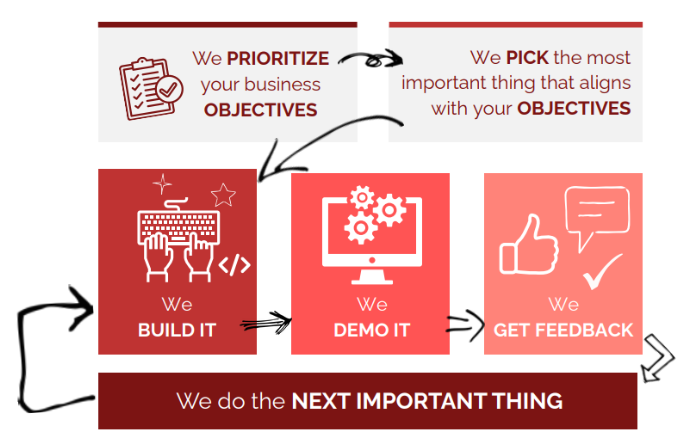
We don't measure success by lines of code written or hours billed. We measure it by whether we've improved these outcomes for your organization.
Frequently Asked Questions About Dedicated Development Teams
How much does a dedicated development team cost?
Costs vary based on team size, expertise level, and project duration. Most dedicated teams range from $300,000-$1,000,000 annually, depending on composition. However, the best software development firms don't try to lock you into yearly contracts. For example, Sketch sells by the iteration, so you buy as many two-week sprints as it takes to get you the software you need. Think of it like software services on a subscription model.
How long should I engage a dedicated development team?
Some engagements can be as short as a couple of months, but most successful partnerships last 6-12 months or longer. The value compounds over time as the team builds deep product knowledge. Our longest client relationship has lasted for the better part of a decade, with multiple successful projects delivered.
What's the difference between dedicated teams and staff augmentation?
Staff augmentation adds individual contractors to your existing team under your management. Dedicated teams provide a complete, coordinated unit that works exclusively on your project without much management burden. Dedicated teams offer better collaboration, product focus, and don't require you to manage individual tasks.
How quickly can a dedicated development team start?
At Sketch, we can assemble and onboard a dedicated team in 2-4 weeks, sometimes even faster. Compare that to traditional in-house hiring, which takes 3-6 months on average. We maintain a bench of experienced developers, cloud engineers, and other specialists who can be deployed quickly to your project.
Do I need to manage the dedicated team daily?
You maintain strategic oversight, but you're not managing individual tasks or daily assignments. You get the benefits of additional capacity without the management overhead.
At Sketch, for example, we hold a daily standup every morning with our primary point of contact from the client. This gives you an opportunity to learn what we did yesterday, what we're doing today, and if we've hit any roadblocks.
Now, with AI, we move so fast that the daily standup is almost like a mini demo for some projects. You can see new working software and give any feedback required. Then we hold a longer demo every two weeks for you and any of your colleagues or other stakeholders you want to invite.
Who owns the intellectual property for code developed by the dedicated team?
You do. All code, designs, and deliverables created by the dedicated team become your intellectual property. This is clearly outlined in our engagement agreements, and we sign NDAs to protect your proprietary information. If you're talking to a vendor who doesn't make this clear, watch out.
What technologies and frameworks does Sketch specialize in?
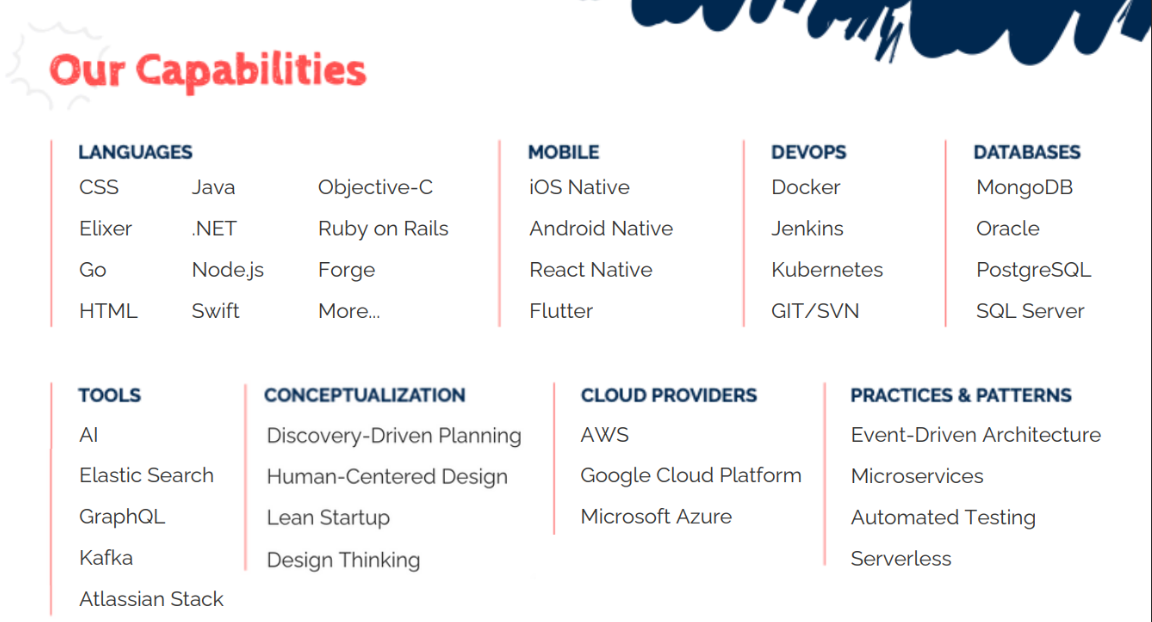
Our teams have deep expertise in all of the following, among many others:
- Frontend: React, Vue, Angular, modern JavaScript/TypeScript
- Backend: Node.js, Python, .NET, Java
- Mobile: React Native, Swift, Kotlin
- Cloud: AWS (we're AWS partners), Azure, Google Cloud
- AI/ML: Integration with OpenAI, Anthropic, custom ML models
- Practices and Patterns: Event-driven architecture, microservices, automated testing, serverless
- Conceptualization: Discovery-driven planning, human-centered design, lean startup, product thinking
- Databases: MongoDB, Oracle, PostgreSQL, SQL Server
- DevOps: Docker, Jenkins, Kubernetes, GIT/SVN CI/CD pipelines, automated testing
We also specialize in Atlassian tools implementation (Jira, Confluence) and can work with your existing tech stack or recommend modern alternatives.
What happens if the dedicated team doesn't work out?
When you find a true on demand app development company like Sketch, you're paying by the sprint. That means you can pretty much get out any time you want. In 10 years, we've never had a client exercise this option, but it provides assurance that you're not locked into a long-term commitment before seeing results. We don't want to be stuck in a bad relationship any more than you do.
How do you handle communication and project updates?
We provide all of the following:
- Daily standups: 15-minute team syncs
- Sprint reviews: Every two weeks to demo working software
- Sprint planning: Collaborative planning for upcoming work
- Retrospectives: Continuous improvement discussions
- Teams (or Slack) integration: Real-time communication
- Project management tools: Atlassian tools like Jira (we're official partners)
You have full visibility into progress, code, and project status at all times.
Can the dedicated team work with our existing in-house developers?
Absolutely. In fact, many of our best partnerships involve collaborative work with client internal teams. We integrate into your existing workflows, use your tools and processes, and act as an extension of your team rather than a separate entity. Our collaborative methodology is specifically designed to make cross-team collaboration seamless.

Ready for Software That Ships on Time? Let's Talk.
For 10 years, we've delivered working software every two weeks without missing a single deadline or issuing a change order. Along the way, we've helped some of the world's best companies get even better. If that track record matters to you, let's talk.
Schedule your free assessment.
Here's what you can expect from us, starting with your first call:
- Assess if a dedicated team fits your specific situation
- Discuss your technical requirements and timeline
- Outline a potential approach (no obligation)
- Answer your questions honestly